Software Development with Lovable
Introduction
AI-assisted development tools are no longer experimental curiosities. They are actively reshaping how products are conceived, built, and iterated upon. Lovable is one of the platforms positioned in this space, promising rapid application development driven by AI.
My own entry point into Lovable was pragmatic rather than ideological. I initially used it as a fast front-end layer on top of APIs I had already built myself. I have a strong preference for the Microsoft ecosystem and typically develop backends in C# within an Azure environment. Instead of replacing that stack, I placed Lovable in front of it.
That setup created an interesting dynamic. I was no longer primarily writing front-end code. I was reviewing, steering, and shaping generated output. As a result, my role shifted from co-developer to architectural reviewer.
What started as "Lovable for frontend, C# for backend" gradually evolved further. Because Lovable integrates tightly with Supabase and provides a capable backend foundation, I found myself slowly letting go of parts of my own backend development as well. Over time, in newer projects, the strict dependence on the Microsoft stack began to fade. Not out of dissatisfaction, but because the alternative proved sufficiently robust and significantly faster to iterate on.
That transition was not instant. It required trust, repeated validation, and conscious architectural review. But once the foundation proved stable, I was able to delegate more of the full-stack responsibility to the platform and operate primarily at the level of system design, review, and architectural intent.
This guide reflects that journey. It is written for developers who care about structure, maintainability, scalability, and long-term ownership. It is not marketing material. It is a technical reflection grounded in real use.
1. What Lovable Actually Is (From a Developer Perspective)
Lovable is best understood as an AI-driven application generation layer. It produces UI, logic, and structural components based on prompts and iterative refinement. Instead of manually scaffolding a project and building features step by step, you describe intent and guide the system toward a working implementation.
Lovable behaves less like a traditional framework and more like a developer who listens extremely carefully, has read an enormous number of books, agrees with you most of the time, and occasionally talks a bit too much.
It is not quite accurate to compare it to a junior developer. A junior typically lacks experience and needs detailed instruction. Lovable, in contrast, has broad contextual knowledge. It understands common patterns, recognizes architectural terminology, and can produce surprisingly mature implementations on first pass.
A better analogy might be a well-read mid-level developer who is highly responsive, rarely argues, implements changes immediately, and happily refactors when asked. The trade-off is that it does not push back unless you explicitly instruct it to evaluate trade-offs. It will optimize for satisfying your request, not for long-term architectural purity unless you make that a goal.
It is also somewhat verbose by nature. If you allow it, it will happily expand features, add helper functions, and introduce supporting abstractions in the spirit of being helpful. That helpfulness is powerful, but it requires guidance.
The real evaluation is not whether it can build something. The real question is whether you can maintain and evolve what it builds without fighting its foundations.
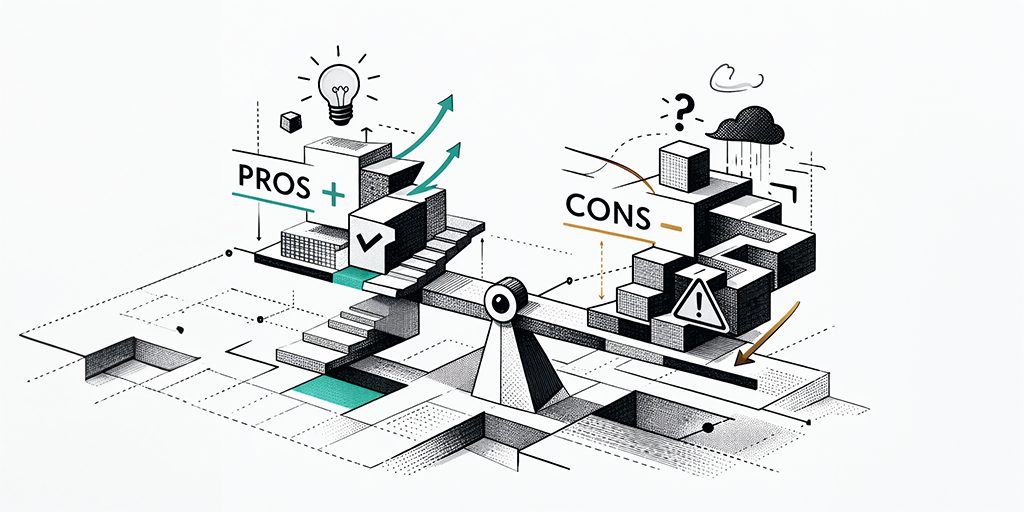
2. The Pros: Where Lovable Adds Real Value
2.1 Extreme Speed of Iteration
Lovable dramatically reduces time to first working version. In my workflow, this meant I could keep my Azure-based C# APIs as the stable foundation while rapidly generating front-end layers against them.
The backend remained explicit, typed, and carefully structured. The frontend became fluid and exploratory. I could validate UX assumptions, user flows, and product hypotheses in hours rather than days.
This separation of concerns was powerful. The domain logic stayed grounded in a stack I trust. The presentation layer became an experimentation surface.
Speed does not remove engineering responsibility. It changes where you apply it.
2.2 Lower Cognitive Overhead in Early Phases
Traditional setup requires immediate decisions about routing, state management, component structure, styling systems, authentication flow, and environment configuration.
Lovable removes much of that early decision fatigue. You are not forced to prematurely optimize architectural choices before validating whether the product direction is correct.
Deferred decisions still return later. But they return once you have evidence that the product deserves deeper investment.
2.3 Product Thinking Over Framework Loyalty
Lovable encourages thinking in terms of flows and outcomes rather than technical perfection.
As someone with a long-standing preference for the Microsoft stack, this required adjustment. Letting go of language preference forced me to focus on architectural principles instead of syntax.
Over time, this proved healthy. Architecture survived. Stack loyalty became optional.
3. The Cons: Trade-Offs and Architectural Friction
3.1 Reduced Architectural Control
You inherit structural decisions made by the generator. For developers used to carefully designing layering, dependency injection boundaries, and domain contracts, this can feel uncomfortable.
Interestingly, this shift forces you into a review role. You stop writing every controller and start evaluating cohesion, coupling, and clarity.
If you lack architectural experience, this loss of control can be risky. If you have it, the platform becomes steerable.
3.2 Hidden Complexity and Architectural Drift
Generated systems can accumulate small inconsistencies. Naming patterns drift. Responsibilities blur. Abstractions multiply.
This architectural drift happens gradually and often invisibly.
The important nuance is that AI is not only a source of drift. It can also be the remedy.
When explicitly instructed to simplify, consolidate patterns, enforce consistency, or realign structure with domain boundaries, Lovable can refactor surprisingly large surfaces quickly.
Drift happens passively. Reshaping requires intent.
3.3 Refactoring as an Explicit Mode
AI excels at addition unless simplification is explicitly requested.
When you consciously switch from feature mode to architecture mode, you can instruct it to:
- Consolidate duplicated logic
- Enforce consistent naming
- Extract domain services
- Reduce unnecessary abstraction
- Reorganize modules around bounded contexts
What would traditionally require days of careful manual refactoring can often be accelerated significantly.
This highlights a broader insight about AI: it has a strong future role as reshaper, recoder, and re-architect of existing codebases. Lovable makes that visible in a product-building context.
There are tools that go even deeper into structural analysis, but that is a topic for another article.
3.4 Platform and Vendor Considerations
Portability matters. Pricing models change. Ecosystems evolve.
Lovable reduces some lock-in through exportability and its AI abstraction layer, but responsible evaluation requires understanding where dependencies truly sit.
Always evaluate exit strategies early.
4. Production-Grade Capabilities
It would be inaccurate to describe Lovable purely as a prototyping tool. It is capable of supporting production systems when used intentionally.
4.1 Supabase as Backend Foundation
Under the hood, Lovable leverages Supabase. This provides:
- Managed PostgreSQL
- Authentication and authorization
- Row-level security
- Edge Functions
- Secrets management
- API generation
- Realtime capabilities
Supabase is not experimental infrastructure. It is a serious backend platform. Understanding Supabase clarifies the true foundation of your Lovable application.
4.2 Security Checks Before Deployment
Lovable includes security validation before deployment. You can run checks, review detected issues, and apply recommended fixes.
This does not replace formal audits for highly regulated systems, but it significantly reduces common configuration errors and insecure defaults.
It embeds a secure-before-deploy mindset into the workflow.
4.3 AI Vendor Abstraction Layer
Lovable exposes a unified AI interface. Through it, you can call providers such as OpenAI and Google Gemini.
If requested, support for vendors such as Claude or Mistral can be integrated as well.
This abstraction reduces tight coupling at the application layer and provides strategic flexibility in AI-driven products.
4.4 Testing and Regression Support
Lovable can generate and execute test scenarios, including unit tests, integration flows, and regression validation after structural changes.
When operating in architectural review mode, this becomes extremely valuable. You can reshape large portions of the system and immediately verify that critical paths still behave as intended.
Testing remains your responsibility conceptually. Execution can be accelerated dramatically.
4.5 Hosting Flexibility and GDPR Considerations
Projects can run on Lovable infrastructure with a custom domain, or you can self-host and choose your own provider.
This flexibility matters for GDPR, data residency, and enterprise compliance requirements.
For European SaaS builders, this is often essential rather than optional.

5. Lessons Learned in Practice
5.1 Treat It as an Accelerator, Not a Replacement
Use Lovable to accelerate experimentation and delivery, while consciously deciding which parts of the system remain architecturally foundational.
In my case, backend ownership gradually shifted as trust increased. That shift was deliberate, not accidental.
5.2 Introduce Guardrails Early
AI generation performs best within explicit constraints.
Define early:
- Naming conventions
- Layering expectations
- Domain boundaries
- Error handling patterns
- Logging strategy
When these principles are clearly stated, Lovable respects them remarkably well.
5.3 Maintain Engineering Fundamentals
Speed can create the illusion of readiness.
Logging, monitoring, observability, performance validation, and clear domain modeling remain your responsibility.
Periodically switch from feature mode to review mode and ask the system to analyze structural quality.
5.4 Pause and Reshape When Complexity Grows
Recognize architectural drift early.
When the system becomes harder to explain at a high level, initiate structural reshaping deliberately. AI can significantly accelerate this phase when guided by clear architectural intent.
5.5 Start with Multilingual Intent Early
If multilingual support is even remotely likely, declare it in your earliest prompts.
Lovable will scaffold internationalization structures automatically. New features will follow that pattern.
Adding multilingual support late requires identifying hardcoded strings, introducing translation keys, validating coverage, and spending significant prompt tokens retrofitting structure.
The AI can assist with translation itself, but early scaffolding is far more efficient than late retrofitting.
6. Production Readiness Checklist
Before declaring production readiness, verify:
- Authentication and authorization correctness
- Row-level security policies
- Logging and monitoring
- Performance characteristics
- Backup and data ownership strategy
- Compliance alignment
If these are not confidently addressed, you are still in prototype territory.
7. CI/CD, DTAP and Deployment Realities
CI/CD is often where modern developer tools are truly tested. Speed of generation is attractive, but deployment discipline determines whether a system survives contact with real users.
Lovable introduces a hybrid model that sits somewhere between traditional platform-as-a-service convenience and self-managed Git-driven pipelines. Understanding this model clearly is essential before adopting it in a serious product.
7.1 Frontend: GitHub as the Control Plane
Lovable integrates bidirectionally with GitHub. Changes made inside Lovable are automatically pushed to the connected repository, and updates from GitHub can flow back into the project.
This has an important implication: your Git repository remains a first-class citizen. You are not locked into a purely opaque platform workflow.
Branching support exists, although still somewhat limited compared to mature GitFlow implementations. With branch switching enabled, you can work with feature branches and pull requests. Combined with GitHub Actions, this enables:
- Linting pipelines
- Automated frontend builds
- Unit and integration tests
- Environment-based deployments
A classical DTAP setup is achievable at the frontend layer by mapping branches such as dev, test, acceptance, and production to different hosting environments with environment-specific variables.
In practice, this means the frontend side of Lovable can fit relatively comfortably into established CI/CD habits.
7.2 Backend: Managed Deployment Model
The backend story is different.
Lovable Cloud and its Supabase foundation handle Edge Function deployment and database updates automatically. When changes are made, they are applied within the project environment without a customizable pre-deployment pipeline stage.
This simplifies operations significantly for small teams. There is no need to manage migration scripts manually or configure separate deployment runners.
However, this model differs from traditional enterprise pipelines where:
- Database migrations are explicitly versioned and executed through controlled stages
- Backend test suites must pass before deployment
- Infrastructure changes are validated through separate pipeline steps
In Lovable, environment separation is achieved by creating multiple projects rather than multiple stages within a single project. For example, one project for development and another for production.
This works, but it requires conscious process design.
7.3 AI Gateway Lifecycle
The Lovable AI Gateway operates through Edge Functions and follows the same deployment behavior as the backend.
Model selection, API keys, and configuration can vary per environment through secrets and environment variables. This allows cost optimization and experimentation between environments.
What it does not provide is an independent AI pipeline with separate approval gates. AI behavior evolves alongside backend changes.
7.4 Where It Differs from Traditional Enterprise CI/CD
For developers coming from heavily governed environments, the differences are important.
Limitations include:
- No built-in multi-stage backend pipeline within a single project
- No mandatory server-side test gate before Edge Function deployment
- No native infrastructure-as-code control over Lovable Cloud resources
- Limited branch workflow compared to advanced GitFlow models
- No direct import of existing complex repositories as fully managed Lovable projects
These constraints do not make the platform unsuitable. They simply mean the operational model is opinionated and optimized for velocity rather than heavy governance.
For startups, internal tools, and many SaaS products, this trade-off is often acceptable and even desirable.
For large enterprises with strict compliance, change-management boards, and formal release trains, the non-traditional deployment model may require adaptation or may not align with policy at all.
7.5 A Pragmatic Hybrid Strategy
A balanced approach can mitigate most concerns:
- Use Lovable as the primary development environment.
- Maintain a separate Lovable project as staging.
- Use GitHub Actions for frontend builds, linting, and automated tests.
- Treat backend changes as platform-managed within each environment.
- Introduce manual review checkpoints before promoting changes between projects.
This hybrid strategy preserves much of the speed advantage while reintroducing intentional control where needed.
The core insight is this: Lovable changes how deployment responsibility is distributed. It removes certain operational burdens while limiting deep customization of the pipeline.
Whether that is a benefit or a drawback depends entirely on your organizational context and risk tolerance.
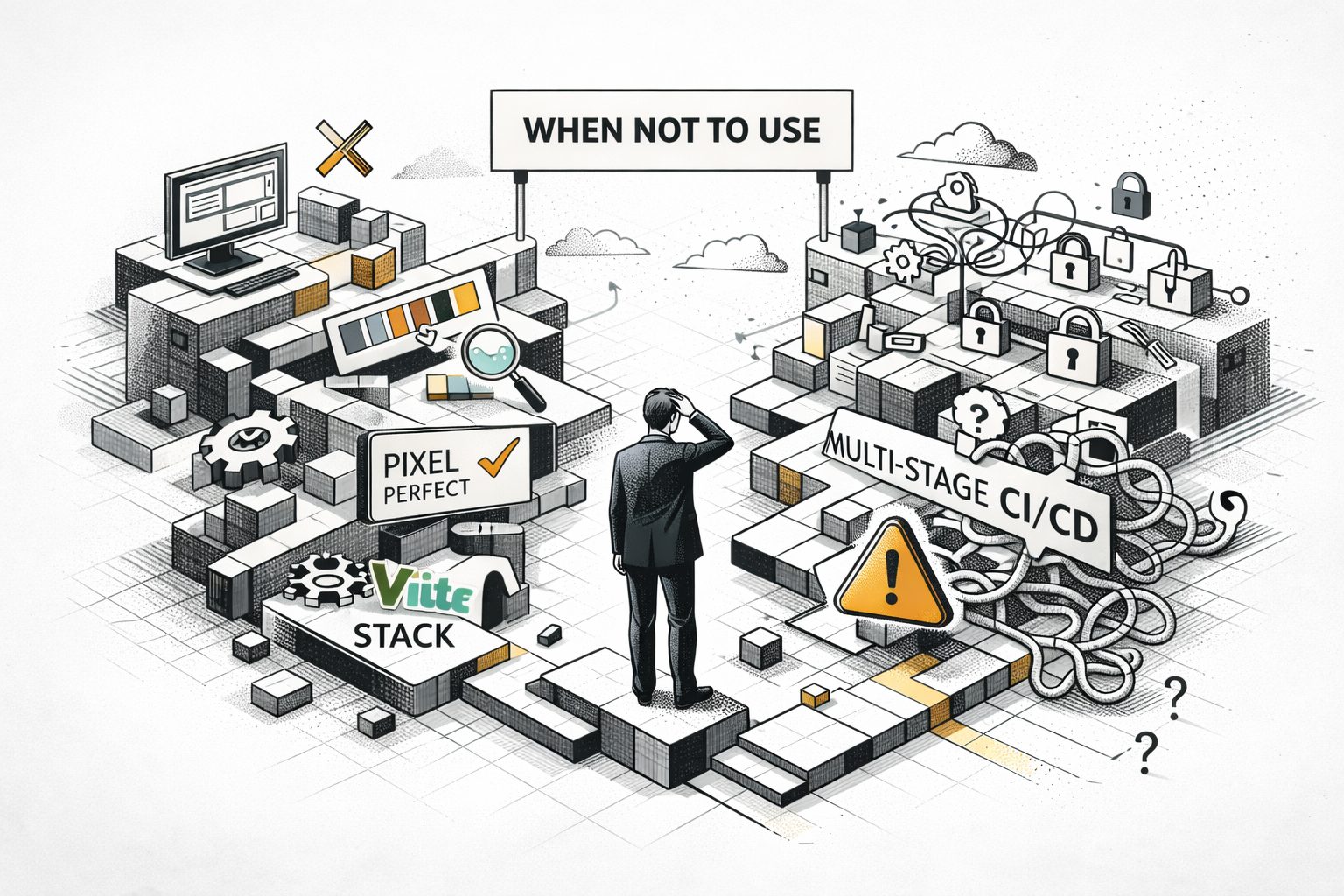
8. When Not to Use Lovable
Every tool has a context in which it excels and a context in which it introduces unnecessary friction. Lovable is no exception.
Understanding when not to use it is just as important as understanding its strengths. In many cases, the decision is not about capability but about alignment with your constraints, mindset, and operational model.
8.1 When You Are Not Building a Web Application
Lovable is fundamentally optimized for modern web applications.
If your primary objective is to build a native desktop application with deep operating system integration, background services, hardware access, or low-level performance constraints, the platform is not a natural fit.
While web-based technologies can sometimes be wrapped for desktop usage, that is not the core strength of Lovable. If your requirements are inherently native rather than browser-based, starting with a desktop-focused stack will likely be more predictable and maintainable.
8.2 When Pixel-Level Design Control Is Non-Negotiable
Lovable generates clean, modern interfaces and responds well to styling instructions. However, it is optimized for productivity, not for endless micro-adjustment.
If your workflow consists of repeatedly refining tiny visual details such as exact shades, spacing adjustments of a few pixels, or hyper-specific design tokens, you may find yourself consuming large numbers of prompt tokens with diminishing returns.
In that case, a traditional hand-crafted frontend workflow with direct control over every CSS rule may be more efficient and less frustrating.
Lovable is excellent at getting you to a professional and coherent design quickly. It is less suited to being driven as a conversational pixel editor.
8.3 When the Underlying Stack Is Unacceptable
Lovable's ecosystem is built around a specific foundation that includes React, Vite, and Supabase.
Even with abstraction layers and export capabilities, this stack influences application structure, deployment model, and operational characteristics.
If you fundamentally reject React-based frontends or Supabase-backed architectures, and you are unwilling to operate within that solution space, Lovable will feel constraining rather than empowering.
The platform works best when you are comfortable being stack-agnostic and focusing on architectural principles instead of framework loyalty.
8.4 When Strict Traditional Enterprise CI/CD Is Mandatory
As described in the previous chapter, Lovable follows a hybrid and opinionated deployment model.
If your organization requires:
- Fully segregated DTAP environments within a single controlled pipeline
- Mandatory backend test suites that must pass before any deployment
- Infrastructure-as-code enforcement for all cloud resources
- Formal release gates governed by change-management processes
then Lovable's non-traditional CI/CD model may not align with your policies.
This does not mean the platform is insecure or immature. It means its operational philosophy prioritizes speed and managed simplicity over deep pipeline customization.
For heavily regulated enterprises, this mismatch alone can be a decisive reason not to choose Lovable.
8.5 When Full Determinism and Deep Infrastructure Control Are Required
Some systems require complete control over execution paths, runtime environments, networking layers, and deployment artifacts.
If you are building infrastructure-heavy systems, safety-critical platforms, or deeply regulated financial or medical software, you may prefer a stack where every layer is declaratively defined and version-controlled through infrastructure-as-code tooling.
Lovable abstracts much of this complexity. That abstraction is a benefit for many teams. In highly constrained domains, it may be a limitation.
Summary: When Lovable May Not Be the Right Choice
Lovable may not be suitable when:
- You are building native desktop applications rather than web applications.
- Pixel-perfect micro-control over every UI detail is essential.
- The React, Vite, and Supabase stack is fundamentally unacceptable in your architecture.
- Strict, traditional enterprise CI/CD pipelines with mandatory backend gates are required.
- Full infrastructure-as-code control and deterministic deployment guarantees are non-negotiable.
In these contexts, a fully self-managed architecture will likely provide better alignment with your technical and organizational constraints.
9. Final Thoughts
Lovable is neither a silver bullet nor a toy. It is a force multiplier when used with discipline.
For experienced developers, especially those comfortable across ecosystems, it enables a shift from implementer to architectural reviewer.
There is also something that is harder to quantify but very real: the fun factor.
The speed at which ideas turn into working interfaces is genuinely enjoyable. Shipping visible progress in hours instead of days creates momentum. It can even become slightly addictive. You make a change, see it live almost immediately, refine it, and iterate again. The feedback loop is tight, and tight feedback loops are energizing.
As someone who historically identified primarily as a backend developer, there is an additional benefit that should not be underestimated: I no longer have to handcraft front-ends unless I explicitly want to. The days of carefully aligning divs, debugging CSS edge cases, or wiring repetitive UI plumbing are largely optional.
There is a quiet relief in that.
The trade-offs discussed throughout this article are real. Architectural drift must be managed. CI/CD differences must be understood. Stack alignment must be evaluated consciously.
But in my experience, the efficiency and speed gains outweigh the drawbacks for the majority of modern web-based SaaS scenarios.
If you are disciplined, clear about architectural intent, and willing to operate in review mode rather than ego-driven implementation mode, Lovable becomes not just a productivity tool, but a leverage tool.
And if you are a backend developer who never secretly dreamed of becoming a full-time CSS specialist, you may find that this shift feels surprisingly liberating.
Want your own application or MVP built with Lovable? See how I help as a Lovable developer →